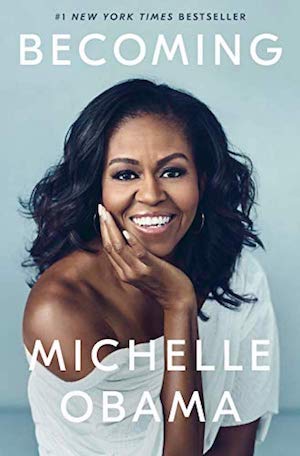
Becoming

Becoming by Michelle Obama is a gorgeous memoir of everywhere she’s been and rescinds the idea of passive conformity.  Mrs. Obama takes readers on her life’s journey of how she worked through her life to be the driver of her own destiny.  

The self-described box checker ticks through the experiences which brought her and her husband as she would call him, to the decision to run for the highest office.  

Those experiences are what made Becoming feel like I was meeting the mentor I always needed but never got.   I felt introduced to a woman full of humility navigating the treacherous waters of life in politics.  She writes as gracefully as a former first lady but as honestly as modern mother raising kids in the 21st century.  Her down to earth mindset felt relatable when I had no reason to relate. 

Mrs. Obama’s interpretation of politics and her understanding that progress in this country tends to pass slowly cuts through the optical carefulness of traditional politics when she admitted to inner-city school kids that no one in politics would be rescuing them.  Some in politics might not even know those kids exist.  She encouraged them to channel their path through school and education which came across as the most honest and encouraging thing she could give to kids.  Telling them not to wait for her or anyone else to change life for them.  

The only thing that rang as ingenuine was when the former FLOTUS spent a chapter talking about how the position of first family constantly made her feel confined due to meticulous schedule planning and secret service protection.  Mrs. Obama in the next chapter talked about her first trip to Walter Reid Medical Center to visit with wounded soldiers and she wrote that she was scheduled to spend 90 minutes at the hospital and ended up spending four hours there.  It felt out of character with the description she previously made of detailed plans that executive branch staff was dedicated to.  But this anecdote doesn’t take away from the sincerity of the woman.

Becoming is a piece of advice offered to the world by an intelligent, determined and passionate woman to take or leave but her honesty is not up for debate. 

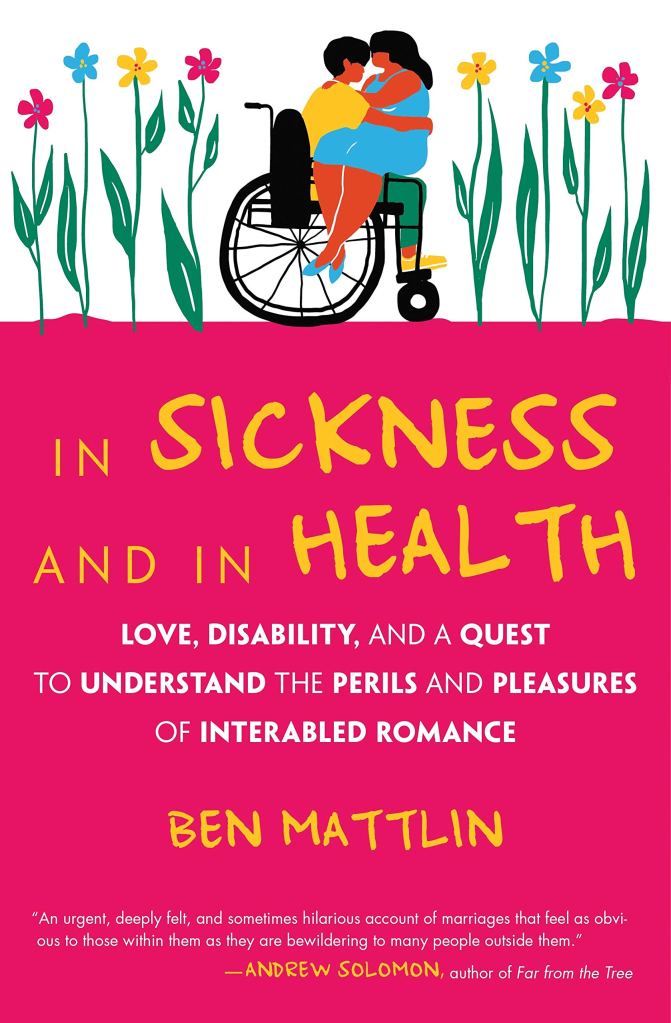
A Disability History of the United States/In Sickness and in Health

As we grapple with ourselves in an explosive time for social justice, I would recommend taking a look back at this country’s past with bigotry and discrimination through the lens of disability.

For this exercise, I’d recommend two books: A Disability History of the United States by Kim E. Nielsen and In Sickness and in Health by Ben Mattlin.  

A Disability History of the United States walks the reader through the historical definition of disability and how the implication of that designation was used to exclude blacks, women and immigrant Americans from institutions in this country.  

In the book there are historical examples of the disabled designation being used to exclude groups.  For example, women weren’t permitted to go to school because they weren’t considered able to “handle” coursework.  When slavery was abolished, groups of black people were declared mentally unfit because they couldn’t “handle” freedoms.  During eugenics, immigrants were labeled disabled and therefore denied entry at Ellis Island for the most superficial reasons.

This idea is important to contemporary issues we face today because by the facing the prejudices rooted in the country’s past and building, it’s understandable to recognize that exclusion was not erased when laws were made to end such practice.

The point is driven home by In Sickness and in Health where the author explores the relationships of inter-abled couples and how we face real bigotry in our everyday lives from family and from strangers.  The expression of bigotry exemplified in this book isn’t constrained to disability and able-bodied readers are confronted with their biases in an uncomfortable yet personal way that can serve to teach a lesson about unintended prejudice.

The lesson is that intention and impact are two separate things to consider when we think about how what we say and do.  You may not intend to insult a stranger in a wheelchair when you walk up to them and ask to pray for them, but the impact doing so may have on that person may be burdensome.  This same lesson applies to what we say and do in inter-racial relations.  

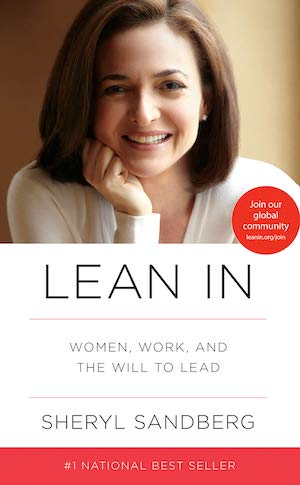
Lean In: Women, Work, and the Will to Lead

Lean in to leadership without sacrificing likability in Sheryl Sandberg’s guide to women in leadership.  It is a gripping instruction on why women hold so few positions of power when we make up half the pool.  

Sandberg provides stacks of information like the leadership role gap between men and women in politics and business which contradicts how girls and boys perform in school.  She brings up glaring differences in how mothers care for their babies such as “mothers overestimate the crawling ability of their sons and underestimate the crawling abilities of their daughters.” 

The author not only explains the differences in how our culture treats men versus women but how and why women retreat from excelling to the top of their fields on their own after education.  Factors like perceptions, expectations and confidence define women and their opportunities.  However, abilities do not define those opportunities.  

Lean In would be an illuminating book for women, career driven or not, because it urges women to not think like a man like some advice, but to acknowledge the rules culturally placed on women and excel at those to get ahead.  This could be clearly applied to a career or any woman who’d like to command her deep will to lead in any circumstance.  

Sandberg makes clear that she doesn’t think it’s fair that women must adhere to different rules than men but the implicit goal is to get more women in leadership to change that expectation.

When it comes to co-parenting and managing careers, Sandberg suggests not only do parents buck entrenched norms, but actively challenge those stereotypes and don’t humble-brag that you’ve done it. She reminds readers that, “gender specific expectations reman self-fulfilling.” 

Sandberg’s advice often comes off as, “it’s so easy you just… one, two three.”  And some of the counsel she suggests were possible because she and her since deceased husband had lives of privilege.  But Sandberg does acknowledge how fortunate she and her husband had been.  

The frankness and deftness Sandberg writes with is a refreshing voice in the self-help book market. 

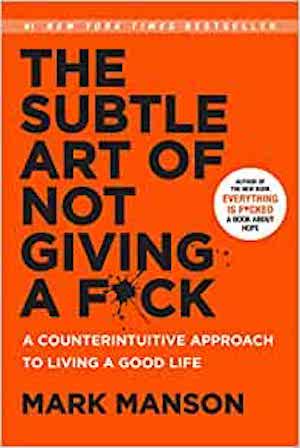
The Subtle Art of Not Giving a F*ck

This blunt title sets the stage for a foolish form of familiar lessons.

Manson brings up “the feedback loop from hell” and our abilities as humans to have conscious thoughts about our thoughts.  He says you can ‘short circuit’ the feelings of guilt, anger and sadness for feeling those exact feelings by not caring because the world is messed up.

The argument that the more you pursue something you don’t have (a quality/material item) the more you reinforce that you don’t have it and the further away it gets is well founded in philosophy.  

Philosophers like John Stuart Mill and Friedrich Nietzsche have thought about the ‘paradox of hedonism.’  This idea isn’t original and plays as a person capitalizing on better thinker’s ideas by presenting it in bite sizes. 

As a former high school Lincoln-Douglas debater (a philosophical type of debate) I resent the thought that people can’t or won’t care about classical philosophy enough to seek it out themselves.   Also, that they need it spoon fed to them in the platitudes of an asshole. 

Cutting down conventional philosophy into morsels of advice for achieving more happiness is witless even if it’s packaged to be edgy.  

The advice to care about what you care about is cliché and obvious, so the rest of the book is just a jerk proving he’s a jerk and swearing a lot.   

Manson does bring up important bullet points that build happiness but these ideas are weighty and complex and cannot be halfway explored in less than 10-minute chapters.

Ideas like victimhood, exceptionalism and problem solving are worth studying but saying that problem solving is vital to happiness and explaining how to problem solve are two different things and Manson fails to actually help with the latter. 

But the author, Mark Manson, won’t even care that some obscure blogger wrote this criticism of his book because he doesn’t give a f*ck.

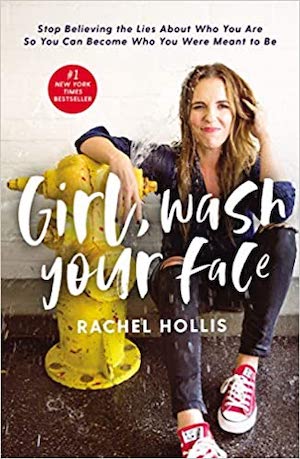
Girl, Wash Your Face

I really wanted to love Girl, Wash Your Face but Rachel Hollis’ perspective is privileged on getting control of your life and hypocritical on sex.  I wouldn’t recommend this book unless you wanted to get your hopes up for some kick ass advice on taking ownership of your life and choices while taking care of yourself only to be let down.  While the book is great at hyping up readers to gain this sought-after advice and it serves to be a wonderful encouragement, it doesn’t actually deliver anything about what you can do other than positive self-talk.  

Girl, Wash Your Face would be a helpful read for any young Christian woman facing a world she is overwhelmed by. Rachel Hollis encourages women to not only take control of their life, but take care of themselves while doing it.  

The fierce determination the author demonstrates in every story of adversity she tells is a true example of womanhood, no doubt.  The medium (book) in which Hollis gives her advice is also ideal because she conveys the importance of taking your time, with yourself and your work whether that is in the home or not, which you can do with a book.  

The book is laid out in the form of lies women believe which Hollis believes holds them back.  Within those chapters, she unravels those lies within her own journey and uses them to teach other women what she has learned mostly from a Christian perspective.  

Some advice is even so obvious to me now as a 28 year old having faced her own hardship and it almost feels condescending to receive the advice she gives but then I remember, if I truly knew these lessons as well as I’d like to believe I do, I wouldn’t have felt like Hollis was saying all the things I wish I had written.  I would have just written them already.  But there are also TONS of self-help books for women out there that don’t constantly brag about how successful the author is and encourages women to stop lying to themselves, ignoring fundamental barriers women face. 

The advice on motherhood and dealing with death are really sound and reaffirming. Some people can really benefit from hearing the advice to attend counseling and get up and press on when you fail. And of course, never take no for an answer when trying for your goals.

Hollis is strictly speaking to the person who considers themselves a woman.  She asserts that her platform welcomes the everywoman and enriches them with advice, friendship and community and is what women of the 21st century are craving in a world where we are so isolated by technology.  

As a woman with a ferocious sense of sexuality, I find it frustrating that Hollis maintains an image of a preacher’s good-girl-daughter.  I know there are women out there who want their role models to reflect themselves in a way of what they desire sexually.   

Her experience as a self-described ‘booty call’ assumes that women she’s speaking to do not have hormonal desires beyond their understanding or control… and she is, because she writes for a Christian publisher.  However, even some Christian women are for lack of a better word, horny.  She misses that.

But, explaining the hurtful way the man (who is now her spouse) treated her will prove to only help women who do not share the intentions of their partner and the manner in which she dealt with those separate intentions.  And it’s a rich lesson coming from a woman who ended up with that man who treated her hurtfully in the beginning. 

The author faces this challenge when she wrote her first book and tried to sell it to publishers.  And while she proves the point that the good girl image can sell, she feeds into the narrative that good Christian girls don’t want booty-calls which is hurtful to her self-described mission to include the everywoman.  

Hollis’ hypocritical positions on things like sex and porn are glaring and show to be a blind spot for her.  Her expressed position on pornography is clear rebuke of how her relationship with her husband began.  Her position on porn is as stated: “pornography, for example, is extremely damaging to both the consumer and people being used as objects for your lust.”  Rachel’s preaching about this comes across as insincere and much like religious preaches screams, “do as I say not as I do.”

In the end, Rachel Hollis is a wonderful role model and like any other role model, they’re human and we all can’t agree on everything.  I appreciate how reassuring her narrative can be at times, and I’ll take what advice I can from her book and I’ll leave what I don’t agree with.
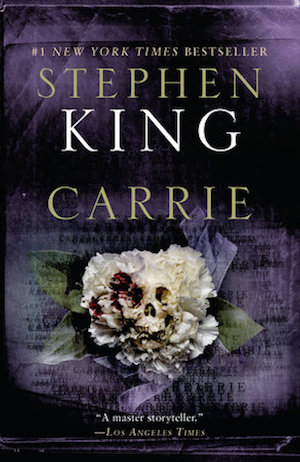
Carrie

You don’t even need to read any Stephen King horror novels to understand that he is a prolific author. Just the staggering amount of tales he has told (61) is hard to wrap my head around as a writer.

In Carrie, King’s descriptions set the scene like I’ve never seen before while reading. I found myself hanging on every adjective as I imagined the character’s faces, clothes and mannerisms. I’ve always had trouble imagining the descriptions I read in books but King writes in a poetic idiosyncrasy that paints a picture of the story he’s telling.

As the plot in Carrie creeps up on you, so do the characters. The elegant technique in which King draws out the storyline and the intentions of the characters] is the most skillful writing I’ve ever read.

When I told my husband I was reading Carrie, he mentioned he had heard that school libraries had been banning the book because of similarities to school shootings. I just think that if fiction is too close to reality for your comfort, maybe the book isn’t the problem.

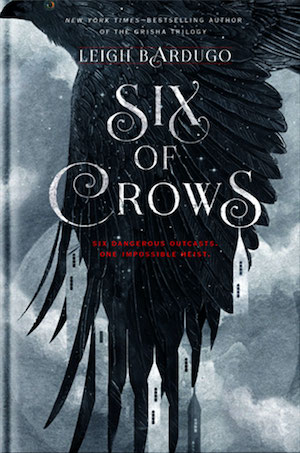
Six of Crows

Kaz Brekker and his crew of specialists excite the mind while working together to pull off what should be a impossible heist.

When you’re slumming it in Ketterdam, it helps if your friends are skilled in things like lock-picking, scaling Walls and shooting firearms.  

Six of Crows is a definite read for thrilling adventure seekers.  The gang known as The Dregs take the reader on shootouts, break-ins and many decisive meetings all while at each other’s throats. 

Author, Leigh Bardugo gives each character a meaningful backstory griping the reader to care about them.  Each character is developed into these rich stories within the novel and reading them is full of emotions like loss and grief. 

The exciting skill sets of each character provides a light and easy dynamic throughout challenges and trip-ups on the pages of Six of Crows.

All these factors would make this book a great standalone novel and that’s what makes it cringeworthy that the story couldn’t be wrapped up in one book.  It’s frustratingly a duology.

Authors are constantly trying to drag out what would be a great story into a bore of a second or third book.  Much like 50 Shades droned on through the second book of nonsensical wild goose chase plots.  

Still,if you’re into provoking heists… its a must read.